
Cally’s Caves 2 Development Blog #8 – More on Level Design in a 2D game

We already posted on some of the thoughts behind the level design in Cally’s Caves 2 a while ago.  In the time since that blog came out we’ve made a number of crucial decisions regarding how the levels will be laid out.  Also, the overall level design is such an important part of developing a 2D game that we figured it would be worth another post to discuss some of the decisions we’ve made.  We’ve already written about how we approach tutorials, the smaller level sizes, and increasing density of objects in a level, so this time we are going to focus on the smaller things that go into making a level for Cally’s Caves 2.

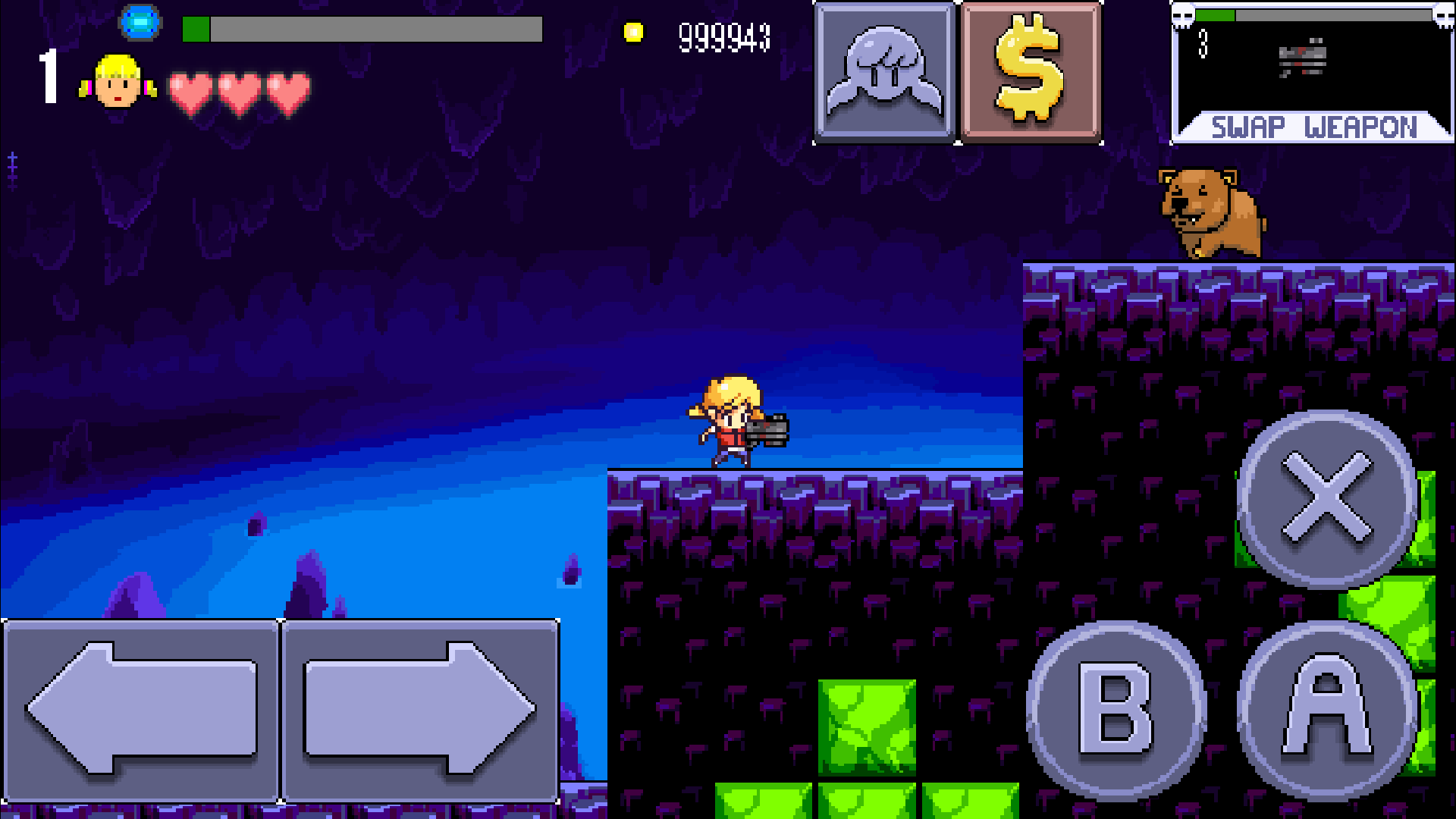
cally and big bear

Hazards 

A good 2D platformer should always be fun to run and jump around in.  Player movement mechanics are incredibly important, and part of developing player movement is figuring out how the player’s interaction with the environment works.  If the player stands on a brick block, they shouldn’t fall through it.  If the player runs into a wall, horizontal movement should stop.  Basic stuff, right?  But if that’s all there is to the game, it might get a bit boring after a while (although plenty of games don’t, and are awesome).  Introducing hazards allows a designer to inject some danger into a level design, which helps keep the player on their toes.  It also increases the reward value for a player when they beat a level.  Would a player feel more satisfaction if they ran down a level that was designed like a hallway, or if they navigated through a maze-like level filled with spikes and lava pits?  We believe the latter provides more opportunity for player satisfaction, although there isn’t an objectively correct answer.

Continue reading

Development Diary #7: Art!

Today’s Dev Diary is written by Yal, who is one of the two artists working on Cally’s Caves 2 (along with OHKO).  She shares some of her experiences and insights into the process of creating art for a 2d platformer.

A guest article? Does that mean… there is a guest?! Um, well, yeah. Long story short: OHKO asked me whether I was interested in helping out doing some weapon graphics for Cally’s Caves 2. I said yes. Done, stop yawning. Now let’s change subject to the actual graphics! =]

Since a large majority of all AAA games released nowadays are FPS games, it’s only natural that they use guns. The problem is, most of them also try to be vaguely realistic, which in turn means all weapons are of the type “fires bullets in a straight line”. Now how fun is that? This also generally results in unbalanced weapons, since if all weapons fire in a straight line, why bother getting more than one? The answer is: because every new weapon is tons better than the previous one, so why bother keeping that anyway?

Contrast that with a game like Cave Story by Studio Pixel:

cave story

 (Official screenshot from the game manual) Continue reading

Development Diary #6: RPG Mechanics

Levelling up and increasing different aspects of a character is one of my favorite parts of playing games. Series like the Elder Scrolls and the Ratchet and Clank games have always kept me hooked through the promise of being able to see a little meter fill up and know I’m about to reach that next level.  Considering how deeply RPG mechanics hook me, it should come as no surprise that Cally’s Caves 2 includes a number of mechanics that will help Cally grow more powerful as the game progresses.  Player leveling, finding weapons, leveling up those weapons, the upgrade shop, and in-game currency – these are the RPG mechanics at the core of Cally’s Caves 2.  Since we are making a sequel we can some of the ideas we had for the original game and taking them as far as we can.

Cally's Caves 2

Continue reading

Development Diary #5: Player Movement and Screen Real Estate

A lot of the decisions behind the original Cally’s Caves movement and combat were made based on the platform the game was shipping on.  Screen real estate is a big issue with iOS games, especially ones that use virtual controls.  A few years ago, an iOS game came out called “Pizza Boy” that utilized a virtual control idea that I thought was brilliant.  Instead of including a virtual joystick that would move in 4 or 8 directions (or using 4 directional buttons), Pizza Boy used a “slider” for left and right movement and simply did away with up and down movement.  I’m not sure if it was the first iOS game to use this tactic (that may be League of Evil, or others), but simplifying the control scheme like that minimizes the amount of screen real estate dedicated to controls.

Pizza Boy for iOS
Pizza Boy for iOS

Continue reading

Development Diary #4 – On Level Design in a 2d Game

One of the greatest challenges developing Cally’s Caves 2 is how to go about designing 100 levels while keeping the game fresh.  Cally’s Caves had 27 levels, not including boss rooms or the challenge “subrooms.”  At the time, it seemed like a good idea to differentiate each level by the use of music, tile sets, and area names.  Every time you entered a new level, a new song would start playing, and every five levels the environment sprites would change.  While this worked to a certain degree, a large number of players played the first few levels and then gave up (either out of frustration at the difficulty, or just not enjoying the game).  This unfortunately led to a number of the levels and environment sets never being seen.  In retrospect, we may have been better off if we had changed the tile set every level and just rotated the four sets that we had.  Hindsight is 20/20, and having that hindsight doesn’t affect the product we already released.  It does, however, allow us to approach a sequel with the lessons we learned in mind.  Hopefully, using the lessons we learned, we can make the levels in Cally Caves 2 do a lot more for the player.


Level 3 of Cally's Caves
Level 3 of Cally’s Caves

Continue reading

Development Diary #2: Art Style

The art in Cally’s Caves was done entirely by my good friend Dave in an open-source pixel art editor called Aseprite.  Well we were very happy with the art as a first effort – Dave taught himself how to do it in just a few short months – there’s always room for improvement, and some of our reviews commented on the art in a not-so-positive way.  I know that with Cally 2 it is incredibly important to have the art be amazing, and comparable to the best art on any iOS game, in order to have the best chance at success.  Things evolved naturally when Dave moved to a different city and let me know that he probably wouldn’t have enough time to do the art on another game (he will be staying on in a design/level editor capacity).

New Icon 144x144

I posted on the TIGsource forums about looking for a pixel artist for Cally’s Caves 2, linking the first game and hoping and praying someone would answer and want to collaborate with me on the game.  Enter Pablo, an artist who emailed me asking if the position was open and sending me a portfolio of some of his work.  I instantly jumped at the opportunity, recognizing his work as exactly what I was looking for.  The first actual work he sent me for Cally’s Caves 2 was this promo image, which you may have seen before on this blog:

Image

Continue reading

Development Diary #1: Making a Sequel

I’ve decided to write a weekly development diary about the process of making Cally’s Caves 2.  I’m doing it mostly as a design tool to help me reflect upon decisions I’ve made while designing the game, with the hope that it will help me think about the ideas from another perspective and help me create the best game I possibly can.  So it’s a personal tool, but if you read it and enjoy it, it certainly can’t hurt!  To begin, here’s a bit of background:

Image

In June 2013, having quit my day job, I decided to try and make a video game with my good friend Dave.  The main barrier we faced in this venture was that neither of us had any experience in game design.  Sure, I had programmed some little bits of software on my Commodore 64 as a kid, but nothing resembling a full game, and that was 20 years ago.  Inspired by the likes of Tom Francis and Steve Gaynor, who both made amazing independent games (Gaynor had experience but left a big company to make a solo game, and Francis had no experience but kept his day job and learned how to do it at night), I enlisted Dave and we set out on the path.  By October we had finished Cally’s Caves, and released it on the iOS Appstore.  There’s no need to get into the thought process behind the design decisions we made here, but since its release we’ve had 7000 downloads and although we didn’t make any money, it was a personal success for us both – we proved to ourselves that we could ship a game.

Image

Continue reading